








Two trips, 1,500+ km driven ourselves, and plenty of lessons later — here’s what we’d want every first-time traveler to know before booking a trip to Morocco…
Morocco is one of those places that can completely surprise you—in the best way.
The food, the colors, the architecture, the medinas, the hospitality, the Sahara… there is a LOT to love.
But Morocco also operates differently from many destinations you may be used to. And there are a few things I wish every first-time traveler knew before booking the flight, not after landing.
Now that we’ve visited Morocco twice, I’ve come to think that this is a destination where a little travel perspective goes a long way. I wouldn’t necessarily recommend making Morocco one of your very first international trips. Not because it’s impossible—it absolutely isn’t—but because having some experience navigating different cultures, customs, transportation, and ways of doing things can make you appreciate and love Morocco so much more.
Here are things you MUST know before you even start planning your trip:
1. This is not a “grab a drink whenever” kind of trip 🍷
Morocco is a predominantly Muslim country, and alcohol is traditionally avoided in Islamic culture. While alcohol is legal in Morocco, drinking is not as widely accepted or incorporated into everyday life as it is in many Western countries.
You’ll find alcohol at some licensed hotels, restaurants, bars, and larger supermarkets, particularly in major cities and tourist areas. Some grocery stores even have separate sections dedicated to alcohol.
BUT don’t expect to walk into every restaurant, café, or corner shop and find a beer or bottle of wine!
Once you venture beyond the major tourist areas, availability can become pretty limited.
If enjoying a cocktail or glass of wine with dinner is important to you, pay attention to where you’re staying. Larger resorts and upscale hotels generally make this much easier.
For us, Morocco was much more of a mint tea, fresh juice, and sparkling water kind of trip—and honestly, that felt like part of the experience!
Something to keep in mind: Morocco’s approach to alcohol reflects its religious and cultural traditions. Be respectful of local customs, and don’t assume alcohol will be readily available everywhere. If enjoying a drink is part of your travel plans, it’s worth checking your options ahead of time.
2. Leave the drone at home 🚫
This one surprised us!
Morocco has some of the most photogenic landscapes imaginable, so naturally you might think:
This is going to be AMAZING with a drone.
Not so fast.
Morocco prohibits bringing drones into the country without prior government authorization. And we’re not just talking about flying one… even having a drone packed in your suitcase can create problems at customs!
Unauthorized drones can be confiscated upon arrival, and flying without the necessary permissions can result in fines.
And yes, this applies to tourists who just want to capture a few vacation photos!
We saw countless places where drone footage would have been incredible, from the golden dunes of the Sahara Desert to the ancient fortified village of Aït Benhaddou.
But this is one piece of camera equipment we absolutely wouldn’t risk packing without obtaining the proper authorization before our trip (and good luck getting any proper documentation lol).
Bottom line: Unless you’ve secured the necessary permits in advance, leave the drone at home and stick to your regular camera. Morocco is spectacular enough from the ground!

3. The Moroccan dirham is a closed currency
Morocco uses the Moroccan dirham (MAD), which is considered a restricted or non-freely convertible currency.
What does that mean for travelers?
Unlike the US dollar or euro, Moroccan dirhams aren’t freely exchanged internationally, and you’re generally only permitted to take up to 2,000 MAD in Moroccan banknotes out of the country!
In other words, you don’t want to end up flying home with a giant pile of leftover dirhams!
As of late October 2026, $1 USD is approximately 9.85 MAD.
For quick conversions, here’s an easy trick: Just divide the price in dirhams by 10 to get a rough estimate in US dollars!
- 50 MAD ≈ $5 USD
- 100 MAD ≈ $10 USD
- 500 MAD ≈ $50 USD
Credit cards are accepted at many hotels, larger restaurants, and tourist-oriented businesses, BUT cash is still king in plenty of situations, especially in smaller towns, medinas, markets, and for smaller purchases.
One thing to know about ATMs: Many Moroccan ATMs limit withdrawals to approximately 2,000 MAD (around $200 USD) per transaction, although some allow more. Daily limits can also apply depending on the ATM and your bank, so don’t assume you can withdraw your entire cash budget at once!
Have cash on hand, and try to get some before even leaving the airport. And if you’re heading into smaller towns or the Sahara Desert, make sure you have enough cash before leaving a major city.
My advice? Stock up at the airport, then withdraw what you need as you go, check for ATM fees, and plan to spend or exchange your remaining dirhams before leaving Morocco!
Exchange rates and currency regulations can change, so verify both before traveling.
4. If you’re planning a Morocco trip in the next few years, know what’s coming in 2030 ⚽
Morocco will be one of the host countries for the 2030 FIFA World Cup, alongside Spain and Portugal.
So if Morocco is on your bucket list, this is worth knowing now.
The country is already investing heavily in infrastructure, transportation and tourism, and the World Cup will bring another enormous wave of visitors.
If you’re dreaming about seeing Morocco before the crowds get even bigger, the next few years may be a very interesting window.
Or… if you’re a huge football fan, 2030 could be THE time to go.

5. There may not be a price tag— but yes, haggling is part of the experience
Walking through a Moroccan souk for the first time can feel like entering a completely different shopping universe.
You may see something you love.
You ask the price.
The seller gives you a number.
You give them a number.
They laugh.
You laugh.
Someone walks away.
Someone comes back.
And somehow, 45 seconds later, you’re holding a handmade ceramic plate you absolutely did not plan to buy. 😂
Haggling is part of the culture in many markets and souks.
And while prices in Morocco can already be very affordable, you can often negotiate an asking price substantially lower with a little back-and-forth—sometimes 20–50% or more, depending on the item and starting price.
But here’s my advice: don’t make getting the absolute lowest possible price your personal mission.
Keep it light. Have fun with it. And remember you’re negotiating over someone’s livelihood.

6. Dress respectfully— modesty matters, but headscarves aren’t required
You don’t need to reinvent your wardrobe for Morocco, but a little cultural awareness goes a long way.
As a predominantly Muslim country, Morocco tends to embrace more conservative styles of dress, particularly outside major cities and tourist destinations. While there is no universal dress code for visitors, modesty is generally appreciated and is a simple way to show respect for local customs.
Think flowing linen trousers, breezy maxi dresses, lightweight layers, and clothing that covers your shoulders and knees. Not only are these choices culturally considerate, but they’re also practical for Morocco’s warm climate.
During our travels, we noticed quite a few American tourists wearing crop tops, exposed belly button rings, and short shorts, seemingly surprised by the attention they attracted. While these outfits might be perfectly ordinary back home, what feels appropriate in one destination may {negatively} stand out in another.
And that’s part of the beauty of traveling: learning to appreciate the customs of the places we visit.
Personally, I found that dressing more conservatively made me feel more comfortable, particularly as we ventured beyond the major tourist destinations. It also allowed for more natural interactions with locals.

But What About Headscarves?
This was something I wondered about before our trip, especially after visiting other Muslim-majority countries.
Female tourists generally are not expected to cover their hair in Morocco. Most mosques are closed to non-Muslim visitors, with the notable exception of the magnificent Hassan II Mosque in Casablanca.
I packed a lightweight scarf just in case, but quickly discovered that I didn’t really need it (even when visiting Hassan II Mosque!).
That said, I did end up wearing one on several occasions, although for very different reasons.
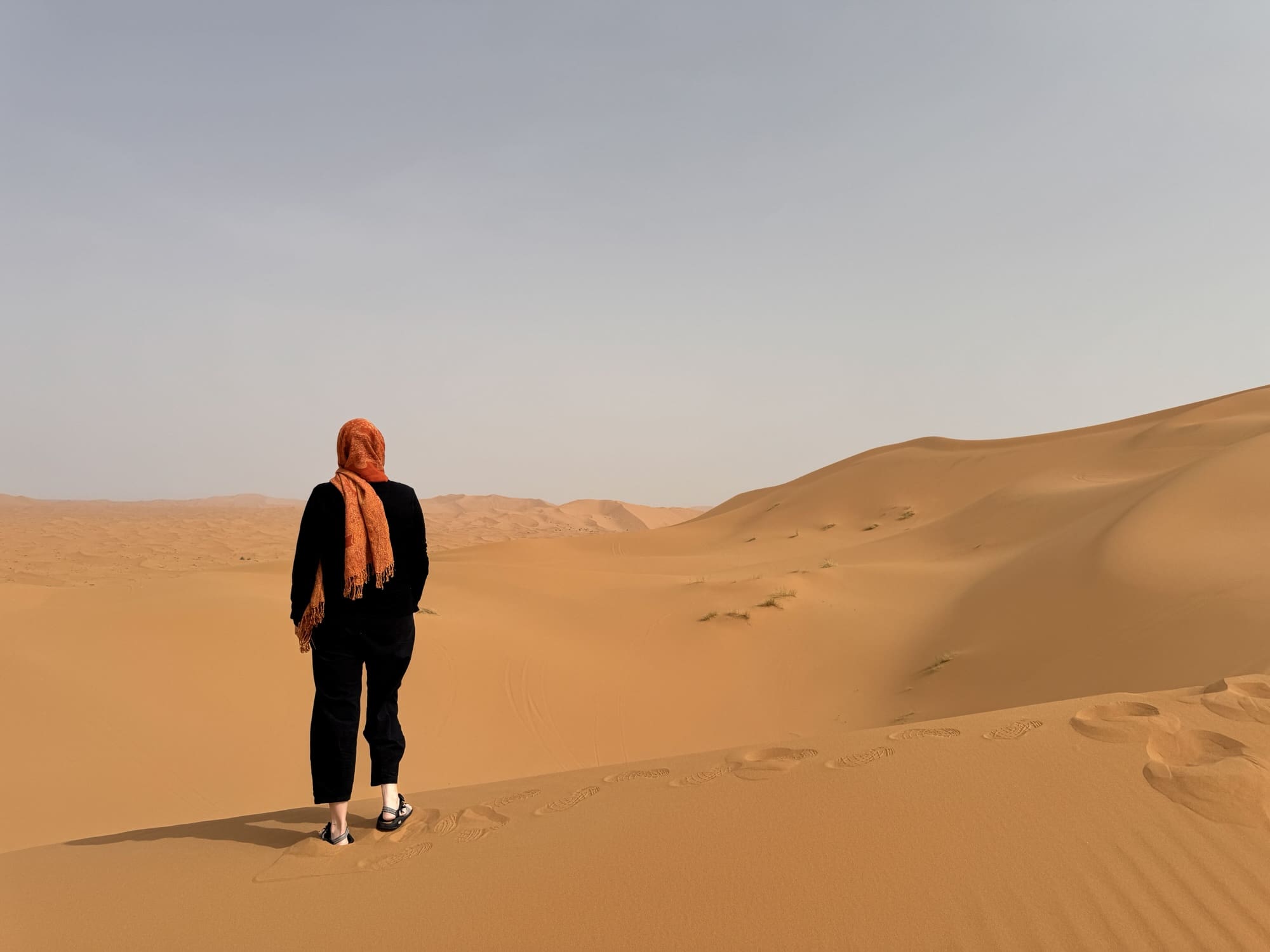
In the Sahara Desert, it was more about practicality than modesty. Between the wind, blowing sand, and desert sun, wrapping a scarf around my head quickly became a necessity rather than a fashion statement!
During portions of our 1,500-kilometer road trip across Morocco, I also chose to wear one in the car. Not because it was required, but because I figured blending in a little more while traveling through smaller towns and rural areas couldn’t hurt.
And after driving more than 1,500 kilometers through Morocco without being pulled over, questioned, or ticketed, I’m giving that scarf at least a little credit. 😉
Of course, I can’t say whether it actually made a difference, but sometimes it pays to blend in!


7. Your new travel essential: toilet paper
This isn’t glamorous, but you’ll be VERY glad you prepared.
Public bathrooms may not always have toilet paper, and you’ll encounter different types of toilets throughout the country, including squat toilets.
Put a small pack of tissues and/or toilet paper in your purse, backpack or day bag and keep some hand sanitizer with you.
It’s one of those things you don’t think about until you desperately need it.
Your future self will thank you.
8. Get cell service before you need it
Between navigating maze-like medinas, pulling up your riad’s address, translating something on the fly, and figuring out where you are after taking approximately 47 wrong turns…
Trust me, having reliable cell service is worth it.
We actually have an international plan through our regular cell phone carrier, which makes traveling abroad incredibly convenient. We don’t have to worry about purchasing a local SIM card or setting up a new plan every time we visit another country.
But if your carrier doesn’t offer international coverage, I highly recommend looking into an international eSIM or Moroccan SIM card before your trip.
While Wi-Fi is common at hotels and riads, I wouldn’t recommend relying on it exclusively, especially if you’re renting a car, exploring smaller towns, or navigating unfamiliar cities.
My advice? Check your carrier’s international coverage and rates before leaving home, and download offline maps as a backup.
Don’t wait until you’re standing in the middle of a maze-like medina with 4% battery to figure out your internet situation.

9. Tipping is a thing—and you’ll want small bills AND coins
Tipping is common in Morocco, but unlike in the United States, there’s not necessarily a standard percentage for every situation.
So, how much should you tip?
At restaurants, 5–10% is generally appreciated, while rounding up the bill is perfectly reasonable for taxis, cafés and smaller services.
For tour guides, private drivers and hotel or riad staff, tipping is also customary, although the amount depends on the service provided.
This is another reason you’ll want to keep smaller denominations of Moroccan dirhams handy throughout your trip!
And here’s an important distinction:
Haggling and tipping are two completely different things.
You can negotiate the price of a souvenir in the market.
That doesn’t mean you should negotiate the tip for someone who just spent eight hours driving you across the country. 😉
My advice? Budget a little extra for tips, keep small bills on hand, and remember that a little generosity goes a long way!
10. Morocco is BIG—don’t underestimate the driving distances
When you look at Morocco on a map, the itinerary can seem totally doable. And it is—but the distances are bigger than they look.
On our most recent trip, we traveled:
Casablanca → Rabat → Chefchaouen → Fes → Merzouga → Ait Benhaddou → Marrakesh
That’s more than 1,500 km of Morocco, with some LONG days in the car.
For perspective:
- Casablanca → Rabat: ~1–1.5 hours
- Rabat → Chefchaouen: ~4 hours
- Chefchaouen → Fes: ~3.5–4 hours
- Fes → Merzouga: ~7–8 hours
- Merzouga → Ait Benhaddou: ~6–7 hours
- Ait Benhaddou → Marrakesh: ~3–4 hours
And remember—those are approximate driving times, not door-to-door travel times. Add stops for food, photos, sightseeing, traffic, bathroom breaks, and the inevitable “wait, we HAVE to stop here” moments.
The good news? The drives aren’t just time spent getting from Point A to Point B. Some of the scenery along the way is incredible, and there are plenty of worthwhile stops—including the Atlas Mountains, gorges, kasbahs and valleys.
Our biggest advice: don’t try to cram too much into each day. Build your itinerary around the driving distances, not just the destinations you want to check off. Morocco is much more enjoyable when you give yourself time to actually stop along the way.

11. Before you get into a taxi, know what you’re getting into
Morocco has different types of taxis, and understanding the basics before you arrive can save you some frustration.
Petit taxis are generally used for getting around within cities, while grand taxis are used for longer-distance travel.
In cities where taxis use meters, ask the driver to turn the meter on. If a driver won’t use the meter, agree on the price before you get in.
And if you’re arriving at an airport or train station, don’t automatically assume the first person approaching you is your official transportation.
When in doubt, ask your hotel or riad what you should expect to pay.
Advice: A five-minute conversation with your accommodation can save you a whole lot of unnecessary negotiation.
12. DO NOT skip the Sahara
If you’re going all the way to Morocco, make time for the Sahara Desert.
Seriously.
There are plenty of incredible cities and experiences in Morocco, but the desert was one of the moments that made the trip feel truly unforgettable.
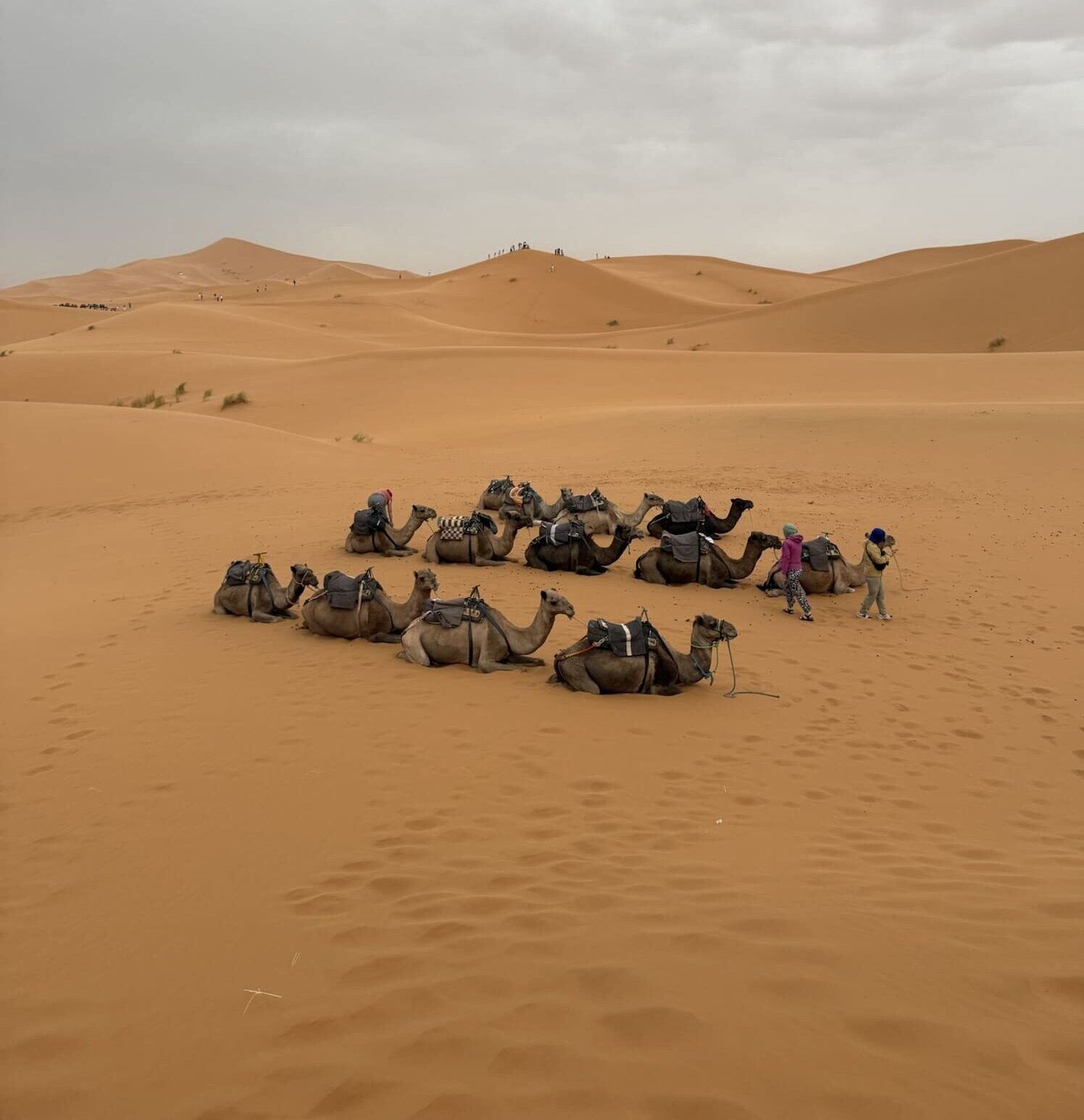
My recommendation? Experience the dunes two different ways: by camel and by ATV!
If your itinerary allows, I highly recommend scheduling one experience in the morning and the other in the evening. There’s something magical about watching the desert transform as the sun rises or sets over the dunes.
A camel ride offers a slower, more traditional way to experience the Sahara, while an ATV adventure lets you explore the dunes with a little more adrenaline. We did both, and I wouldn’t have wanted to miss either!

13. Bring long sleeves to the desert
This sounds completely backwards. You’re going to the Sahara.
Obviously you pack for heat.
But bring a lightweight long-sleeve shirt.
Because when the wind picks up in the desert, the sand doesn’t politely stay on the ground.
It gets EVERYWHERE.
Your face.
Your hair.
Your ears.
Your camera.
Your bag.
Your entire existence.
A lightweight long-sleeve layer gives you protection from both the sun and the sand.
Future-you will be grateful.
14. Learn a few important words in Arabic
You don’t need to become fluent in Arabic before visiting Morocco.
But learning a few basic words can go a LONG way.
Salam — hello
Shukran — thank you
La, shukran — no, thank you
And honestly, “La, shukran” became one of my most-used phrases of the entire trip. 😂
Especially when shopping.
If someone was particularly persistent, saying la, shukran in Arabic seemed to work like a charm.
It’s a small thing, but making even a little effort to speak the local language can change the tone of an interaction.

15. Don’t photograph people without asking
Morocco is ridiculously photogenic.
The colorful markets. The medinas. The architecture. The desert. The people.
But just because someone happens to be standing in the perfect spot for your photo doesn’t mean they necessarily want to be in it.
When in doubt, ask.
This is especially important when photographing women, children or people in more traditional settings.
And be aware that some performers or people posing for photos may expect a small payment.
A simple gesture of respect can make a huge difference.

The biggest thing to know?
Don’t plan Morocco like you would plan a typical European vacation.
Morocco isn’t just about checking off the major cities.
Morocco is more than just Marrakech.
It’s about the winding medinas.
The roadside stops.
The mint tea.
The unexpected conversations.
The tiny restaurants.
The desert silence.
The colorful markets.
The people you meet along the way.
And sometimes… getting completely lost.
Go with a plan—but leave room for Morocco to surprise you.
Because that’s where some of the best memories happen.


Read the Comments +